A router lift can make a router table much easier to use, but not every router fits every lift.
Compatibility can depend on the router motor’s diameter, housing design, the lift’s clamping system, and whether an adapter or collar is required. A router that appears to be the right size should not automatically be assumed to fit.
This guide explains the main compatibility factors and how to check a router and lift combination before buying.
Start With Our Router Lift Compatibility Finder
If you already know your router model, the quickest option is our Router Lift Compatibility Finder.
Check Your Router → Router Lift Compatibility
The finder uses researched router-to-lift relationships and separates results into:
Manufacturer Verified — Supported by manufacturer documentation.
Requires Modification — An adapter, collar, drilling, or another stated change is required.
Unverified — We have not found sufficient authoritative evidence to claim compatibility. This does not mean the combination is incompatible.
Incompatible — Authoritative evidence indicates the combination does not fit.
Why Router Lift Compatibility Is Not Universal
A router lift normally holds the router motor beneath the router table and provides above-table height adjustment.
The problem is that router motors are not all built to the same dimensions or housing design.
Two routers can have similar power ratings while using different motor diameters. Even routers with similar dimensions can have other differences that affect whether they can be safely mounted in a particular lift.
That is why compatibility should be checked by exact router model and exact router lift, rather than simply by horsepower or brand.
1. Router Motor Diameter
Motor diameter is one of the most important compatibility measurements.
Different router lifts are designed to clamp particular motor sizes or accommodate several sizes through adjustable clamping systems.
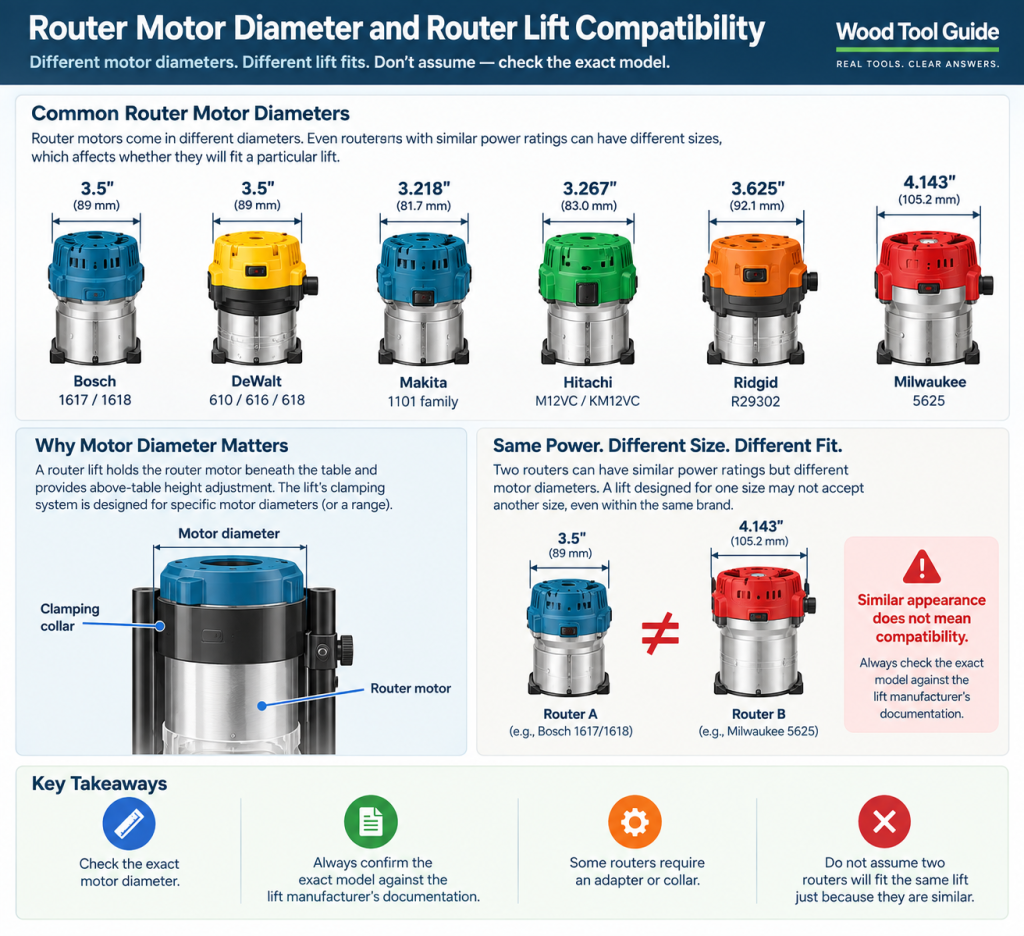
For example, commonly documented router motor sizes include approximately:
- 3.5 inches for several Bosch 1617/1618, DeWalt 610/616/618 and Porter-Cable 690/890 models
- 3.218 inches for the Makita 1101 family
- 3.267 inches for Hitachi M12VC/KM12VC
- 3.625 inches for Ridgid R29302
- 4.143 inches for Milwaukee 5625
- 4.2 inches for several full-size router motors
These dimensions illustrate why a lift designed around one motor size should not automatically be assumed to accept another.
Always confirm the exact model against the lift manufacturer’s current documentation.
2. Direct Fit vs Adapter or Collar
Compatibility does not always mean the router installs directly into the lift.
There are generally two situations.
Direct Fit
The lift’s clamping system directly supports the router motor.
No additional reducer or adapter is required beyond the manufacturer’s normal installation procedure.
Fit Requiring an Adapter or Collar
Some lifts are designed primarily for a larger motor diameter but can accommodate smaller motors using an adapter collar or reducer.
For example, some router lifts use an optional collar to accommodate selected smaller-diameter router motors.
Wood Tool Guide classifies these relationships as Requires Modification when an additional adapter, collar, drilling operation, or other stated change is necessary.
That distinction matters because a buyer may otherwise purchase the lift and discover that another component is required before installation.
3. Motor Diameter Alone Does Not Prove Compatibility
Matching motor diameter is useful evidence, but it is not enough by itself.
Housing shape, electrical design, switches, projections and other physical features can prevent installation even when the nominal diameter appears suitable.
For this reason, Wood Tool Guide does not mark two products as Manufacturer Verified merely because their measurements appear to match.
We look for documentation connecting the actual router model or family with the lift.
4. Router Model Numbers Matter
Small differences in model numbers can represent meaningful product differences.
A compatibility chart might list a router family, an older model designation, or a motor model rather than the name printed prominently on a current retail package.
We therefore distinguish between:
- exact model matches,
- manufacturer-documented model families,
- documented successor or renamed models,
- and combinations where the relationship cannot yet be established confidently.
We do not assume that two similarly named routers are interchangeable.
5. Router Lift Compatibility Is Different From Router Plate Compatibility
A router lift and an insert plate are related components, but their compatibility questions are different.
A router lift must securely hold and operate the router motor.
An insert or mounting plate may instead attach to the router or its base using a particular bolt pattern.
A router might therefore fit a particular plate while not being suitable for a particular lift—or require a different installation method.
Later versions of the Wood Tool Guide compatibility database will increasingly connect routers, lifts, insert plates and router tables so these relationships can be checked separately.
How Wood Tool Guide Verifies a Match
We prefer authoritative sources such as:
- Manufacturer compatibility charts
- Manufacturer manuals
- Manufacturer product documentation
- Other authoritative documentation when manufacturer information is insufficient
For every researched relationship, we record the evidence source and the date it was checked.
We also distinguish between confirmed compatibility and combinations for which we simply have insufficient evidence.
You can read the full process on our How We Verify Compatibility page.
Before Buying a Router Lift
Before ordering a lift, confirm:
- the exact router model,
- whether the manufacturer explicitly supports it,
- the router motor diameter where relevant,
- whether an adapter or collar is required,
- whether any drilling or other modification is required,
- and whether the lift or router has model-specific limitations.
Do not rely only on photographs, horsepower ratings, or an apparently matching motor diameter.
Check Your Router
Already own a router?
Use the Router Lift Compatibility Finder to see the relationships we have researched so far.
Check Router Lift Compatibility →
Our database is being expanded as additional manufacturer-supported relationships are researched and verified.
Compatibility information can change as manufacturers revise products and documentation. Wood Tool Guide records the source and date checked for each researched relationship. Always review the linked manufacturer documentation before purchasing or installing equipment.